
Range Test and Comparison of 10 Rifle Suppressors Including Ridgeback Rhodie and Rhino
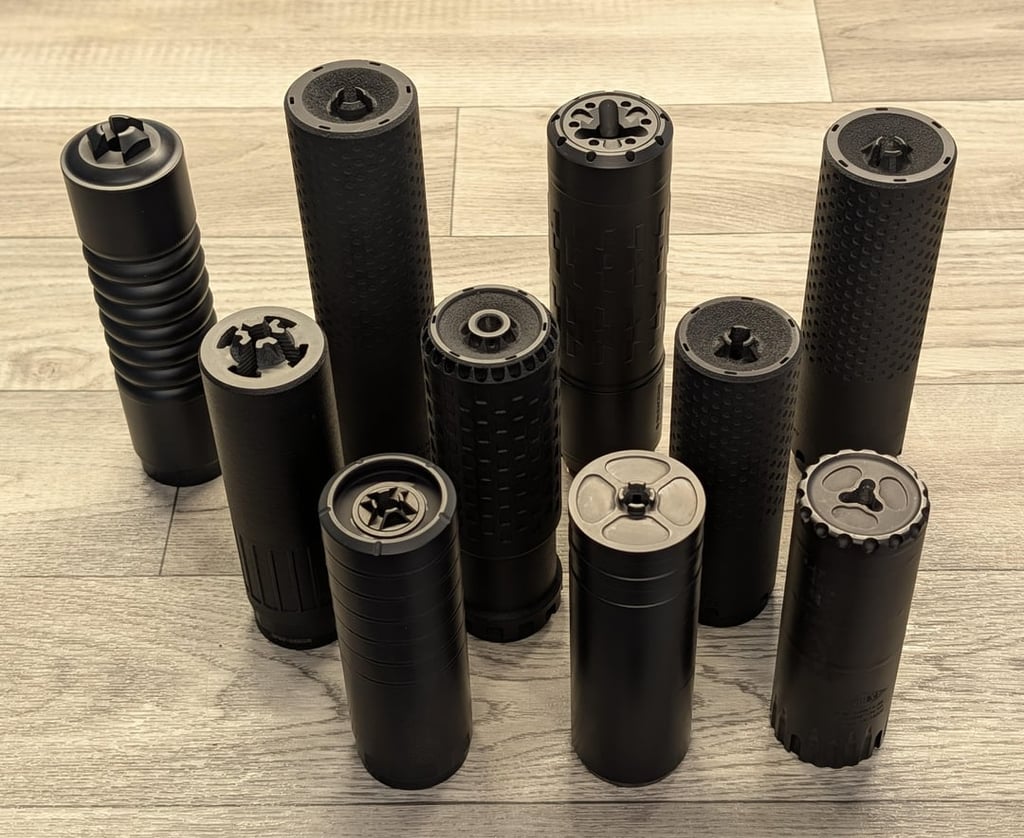
*Click to expand images
I've gotten a lot of questions about the Ridgeback suppressors and how they compare to other offerings on the market. Earlier today I shot them back to back with my other rifle suppressors.
Full list: Rhodie 6, Rhino S, Rhino X, Sahara 300, Velos 762, White Bread, Polo K, Stacy's Mom K, AB A10 762, Turbo K-RB.
TL;DR:
I think they're excellent suppressors, especially at the relatively low price point.
Transparency note:
We have a business relationship with Ridgeback. They carry our muzzle devices and suppressor adapters and offer them as an optional add-on with their cans. I did my best to represent my experiences as accurately and neutrally as possible, but it's possible I have some bias due to this.
Test method:
We went out to the range today and shot a bunch of rounds through each of the suppressors back to back multiple times. We stood in the same spots and took notes after each one for gassiness and sound. Considering I don’t have Jay’s fancy sound metering equipment, I think this is a decent way to compare them.
Host:
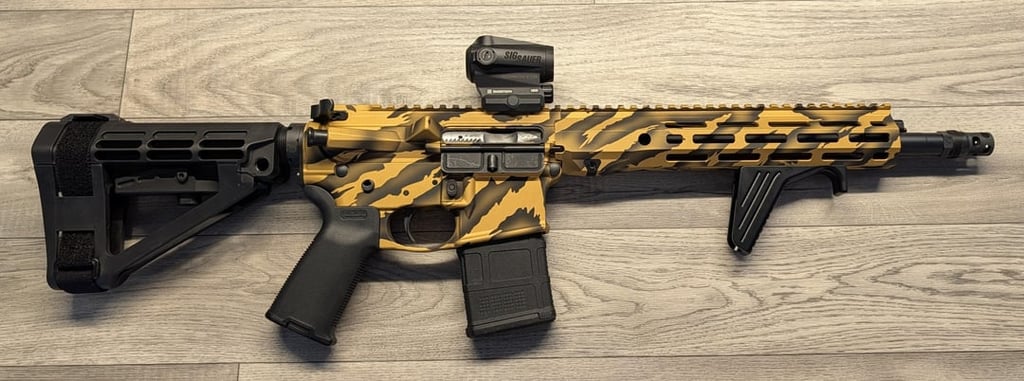
The host was my heavily tuned 12.5 mid-length rifle. It has an AGB, KAK down vent BCG, and A5 buffer system. This is about as good as I can achieve for gas mitigation. I opened up the AGB by +5 clicks when shooting the printed suppressors as there wasn't enough backpressure to cycle otherwise. It has a compact Plan-B brake for suppressor mounting.
Chart Notes:
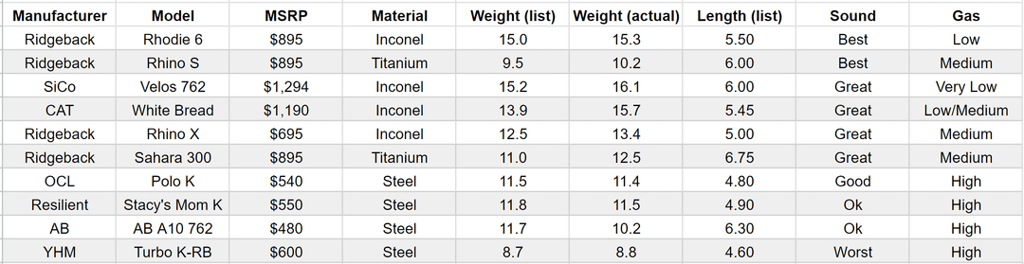
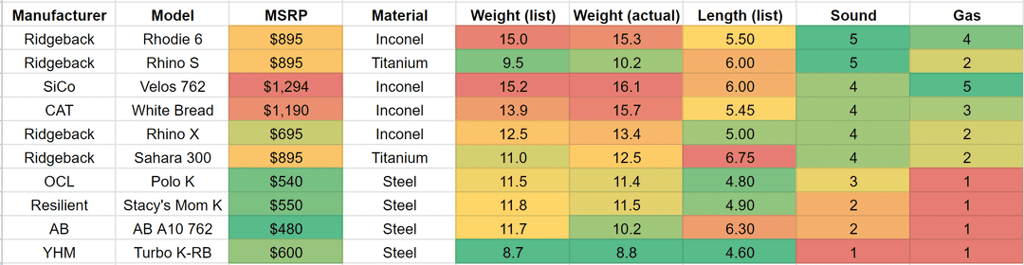
The two charts show the same data, but the second one is color coded. They're sorted by sound suppression first, then gassiness as the tie breaker.
Regarding the actual/measured weight, some of these cans have a bunch of rounds through them and I don't really keep track, so take those values with a grain of salt. All weights are given with no mounting hardware. I ran these today with a titanium Plan-B HUB adapter which adds 0.9 oz, except for the Velos which uses a titanium Charlie LPA (1.4 oz).
For the purpose of this test, sound performance is all relative to the Polonium K. I picked this as a baseline since it’s a very popular suppressor, and I’m assuming a lot of people either have one or have heard it shot before.
Ridgeback Rhodie 6:
The Rhodie 6 is, as an overall package, the best of the suppressors I shot today. It has low backpressure, second only to the Velos, and sounded noticeably better with a pretty low tone. The Velos has been my “main” suppressor for the last few months, but the Rhodie will likely be replacing it for a lot of future range trips. $895 makes this a very strong offering for a general use 5.56/6mm suppressor, especially for people who don’t feel like heavily tuning their rifles.
Ridgeback Rhino S:
The Rhino S also has great sound performance, similar to the Rhodie. Backpressure was medium. I wasn’t getting gassed out, but I could still feel it at some points. The biggest advantage of the Rhino S in my opinion is the excellent sound performance relative to weight. At ~10 oz it was the lightest of the high performing suppressors I tested today. MSRP is also $895.
SilencerCo Velos 762:
The Velos has the lowest backpressure of all; I got nearly zero gas even with rapid strings of fire. Sound performance was good, but fell behind the Rhodie 6 and Rhino S. The main drawbacks of the Velos are the high cost ($1,294 MSRP) and the fact that it uses Charlie threads rather than standard HUB threads. I ran it with the titanium Charlie LPA. The ASR parts it comes with are very heavy, adding almost 8 oz plus a significant amount of length over the listed specs. That aside, the Velos is a great pick for users wanting a hard use, very low backpressure suppressor, and prefer to stick with more established companies.
CAT White Bread:
The WB has low to medium backpressure and very good sound performance. It’s reasonably compact and uses standard HUB threads which makes it a very well rounded choice. It is slightly heavy, and for whatever reason mine measured almost 2 oz heavier than the listed max mil core weight, but on a shorter barreled rifle it’s not a big deal if you’re using a reasonable mounting setup. The use case is pretty much the same as the Velos, but with less of an emphasis on very low backpressure. MSRP is listed at $1,190, although this varies depending on material and mounting interface.
Ridgeback Rhino X:
The Rhino X is the shortest of the printed suppressors that we ran today. At 5” and ~13 oz, it’s easy to put on most rifles without ruining the balance. This is a good pick for people concerned with flash performance (so avoiding titanium), but want to keep a relatively lightweight setup. It sounded very good, and honestly I’m not sure I could pick between it and the WB in a blind test. Backpressure is medium, similar to the Rhino S. This is more than the WB, Rhodie, and Velos, but still not bad overall, and I think most people won’t be bothered by it. The biggest selling point for the Rhino X is the low cost of $695 MSRP. This puts it within ~$150 of the traditionally baffled suppressors, but with better performance.
Ridgeback Sahara 300:
The Sahara 300 is optimized for subsonic 300BLK, but it did very well on the 12.5” 5.56. It’s similar to the Rhino S overall, but 3/4" longer and has slightly reduced suppression with a higher tone. Gas was medium, which is probably intended because if it’s too low it won’t cycle well with some subsonic loads. I typically like to have caliber dedicated suppressors, but if someone wanted a single suppressor to use on both 7.62 and 5.56 hosts, I think this would be a reasonable pick. MSRP is $895.
Otter Creek Polonium K:
As mentioned above, the Polo K is my “baseline” suppressor which I compared the sound performance of the rest to. It’s probably my favorite traditionally baffled 5.56 can overall. Although the sound performance wasn’t as good as the printed suppressors, it’s the best of the machined ones. Backpressure was high, but that’s expected for this type of can. At $540 MSRP, it’s a great value for people who are willing to tune their rifles.
Stacy’s Mom K:
The Stacy’s Mom K is functionally about the same as the Polo K, but doesn't sound quite as good. Backpressure was still high. I know they have a vented end cap that reduces backpressure, but to me it doesn't really make sense to put another $75 into this type of can when you can just save up and buy a better suppressor. I also heard from another owner that it ends up not sounding very good. MSRP is $550. No reason to pick this over the Polo K in my opinion.
AB A10 762:
The AB A10 7.62 is also functionally about the same as the Polo K, but is longer and with a 30 cal bore. The increased length sort of makes up for the overbore, but like the Stacy’s Mom K, it just doesn't sound as good as the Polo K. It might be slightly less gassy, but it still has high backpressure overall. With an MSRP of $480, it is the cheapest option, so maybe it would be ok as a multi cal suppressor on a super tight budget? But you’d still be better off saving up for a Polo in most cases.
YHM Turbo K-RB:
Starting with the good points, the Turbo K-RB is the shortest and lightest suppressor tested today at 4.6” and 8.8 oz. Unfortunately, the good points end there. The “reduced backpressure” part is hugely overstated, and it has similarly high backpressure to the other trad baffled cans. As far as I can tell the only actual change made from the last gen is a couple tiny holes in some of the baffles. It sounded the worst of the 10 tested and was very loud to both the shooter and the bystander. At an MSRP of $600, this just isn’t a competitive offering in the current market.
Backpressure note:
When I say a suppressor has “medium backpressure”, this is partially in reference to cans like the Velos which have basically zero. It’s still very manageable, and is a huge improvement over traditionally baffled cans. You probably won’t be getting gassed out with them and I think a lot of people won’t really notice depending on their environment and personal tolerance to gas. Just adding a note here because as I was rereading all of this I realized it might not be clear.
Future tests:
At some point I may do a comparison of the Sahara 300 on 300BLK (since that’s the cartridge it’s designed around). But this won’t be as comprehensive since I don’t have as many 30 cal cans. We’ll see.
I’m also waiting on approval for a SAW Tisha. I’ll probably make a quick post once I get some rounds through it.
Anyway, I hope you found some of this information useful.
Have a great weekend!
Nathan Comstock


Privacy Policy
© 2026 Comstock, Inc. All rights reserved. Comstock Armory is a registered trade name of Comstock, Inc.
Follow us!